
The story of Henry Ford and the Ford Model T is the story of a mechanic from a Michigan farm. After two failed companies, in 1908 he released a simple, cheap car for everyone. The Model T, nicknamed "Tin Lizzie", became more than three times cheaper thanks to the moving assembly line. It sold more than 15 million units and put all of America behind the wheel.

In this story:
- Who was Henry Ford and how did he start?
- Why was Henry Ford considered a failure?
- When did the Ford Model T appear and what was it like?
- How did Ford's assembly line change car manufacturing?
- What did "five dollars a day" mean at Ford's factory?
- What went wrong: Edsel, Chevrolet and the dark side of Henry Ford
- What happened to the Model T and the Ford company next?
Who was Henry Ford and how did he start?
A January frost, Detroit, thousands of men at the factory gates. We will come back to this scene: it explains why Ford is still remembered today. But it all began on a farm in Michigan, where a boy was taught to look after horses, not engines.
Henry was thirteen when his mother died. His father saw him as the successor to the family farm, but the son was drawn to machines. He took pocket watches apart and put them back together, making the tools for it himself. At sixteen he went to Detroit as a machinist's apprentice.
We told this story in 3 minutes — watch it, and then come back for the details that aren't in the video.

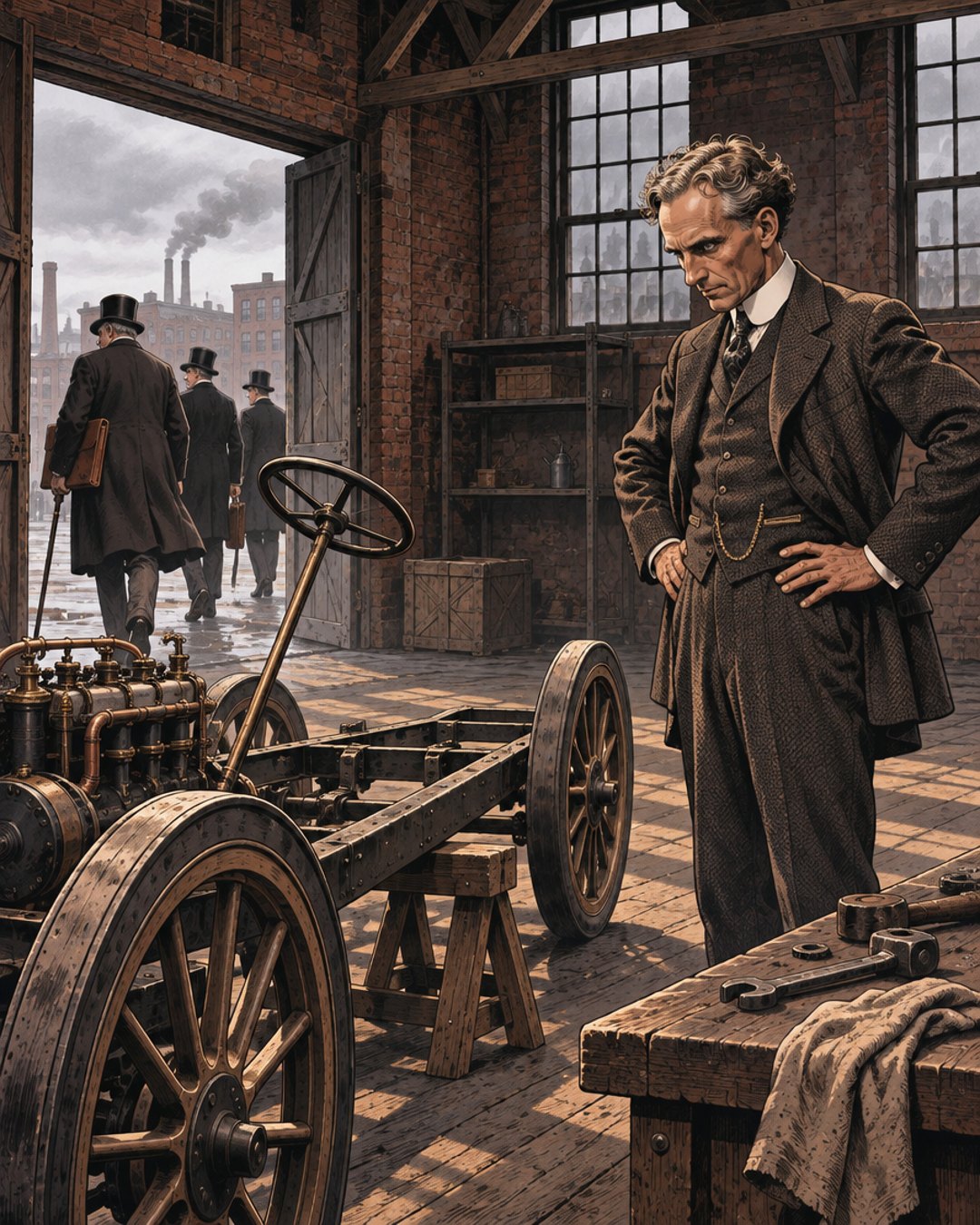
Then came years in workshops and at Edison's electric company in Detroit, where Ford worked his way up to chief engineer. By day he worked with turbines and dynamos. At night he worked on his own project in a brick shed behind his house: a "horseless carriage" on bicycle wheels with a gasoline engine. He called it the Quadricycle.

His wife Clara was by his side. According to biographers, Ford called her "The Believer". She supported her husband when others considered his nighttime sessions in the shed a eccentricity.
The most famous legend about this shed concerns the day the machine was ready. The door turned out to be too narrow. Ford, they say, did not rebuild anything: he broke the bricks and rolled the Quadricycle out through the gap. The first drive took place at dawn, in the rain.


Why was Henry Ford considered a failure?

The Quadricycle caught the attention of wealthy Detroiters, and Ford received funding for his first car company. Here a trait appeared that would later make him both a genius and a tyrant. He would not release a car for sale until he considered it perfect. In about a year and a half the company assembled around two dozen cars and closed without ever making a profit.
The second attempt lasted even less. The investors wanted to sell cars, while Ford was absorbed in racing and refining the design. Within a few months he left. The irony is that without him the company became Cadillac — a brand made precisely for the rich.
He was nearing forty: two closed businesses and whispers behind his back. He founded his third company, Ford Motor Company, with almost no room for error. And that was when he changed the goal. Now it was not a toy for the wealthy, but a simple, sturdy and cheap car for the farmer and the worker.
When did the Ford Model T appear and what was it like?

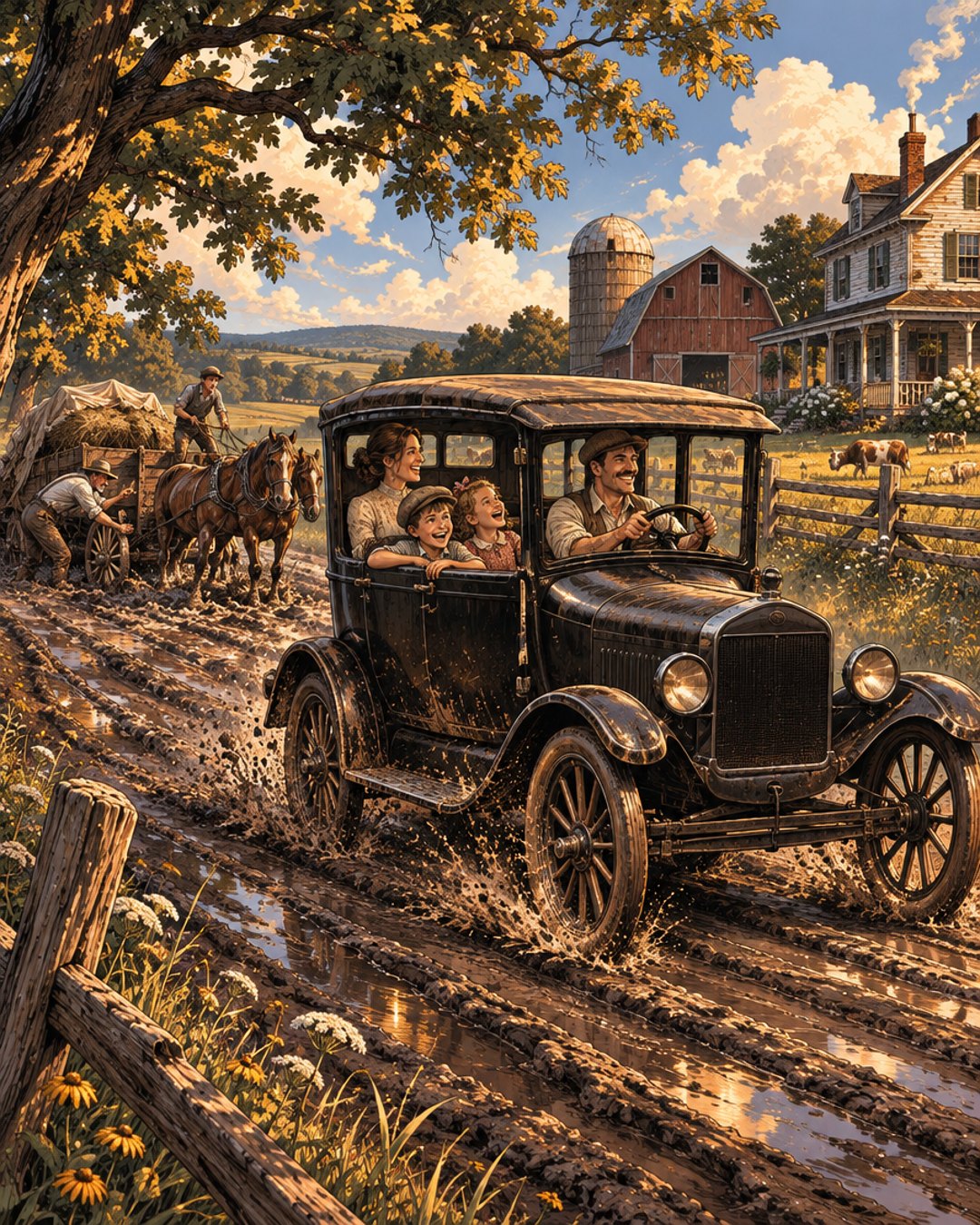
The Model T was unveiled in the fall, at a small plant on Piquette Avenue in Detroit. Tall, light and with high ground clearance, it was designed for American dirt roads, which turned into mud after rain. For chassis parts Ford used vanadium steel: at the time it was stronger than ordinary steel.
The controls were unusual too. The planetary transmission with two forward gears was shifted with pedals. Any farmer with a set of wrenches could repair the car, and spare parts were easy to find even far from big cities.
Why "Model T" and where does the nickname "Tin Lizzie" come from?
The name is prosaic: Ford designated his models with letters of the alphabet. Before the T there were, among others, the Model A, K, N, R and S. The nickname "Tin Lizzie" stuck later, and its origin is still debated. According to the most common version, "Lizzie" was what simple, hardy workhorses were commonly called in those years, while "tin" hinted at cheapness.
Car specifications
| Parameter | Value |
| Model | Ford Model T |
| Years of production | 1908–1927 |
| Engine | inline 4-cylinder, 2.9 L |
| Power | 20 hp |
| Transmission | planetary, 2 forward gears, pedal control |
| Production run | over 15 million |
| Price | from $825 at launch to about $260 in the mid-1920s |
How did Ford's assembly line change car manufacturing?
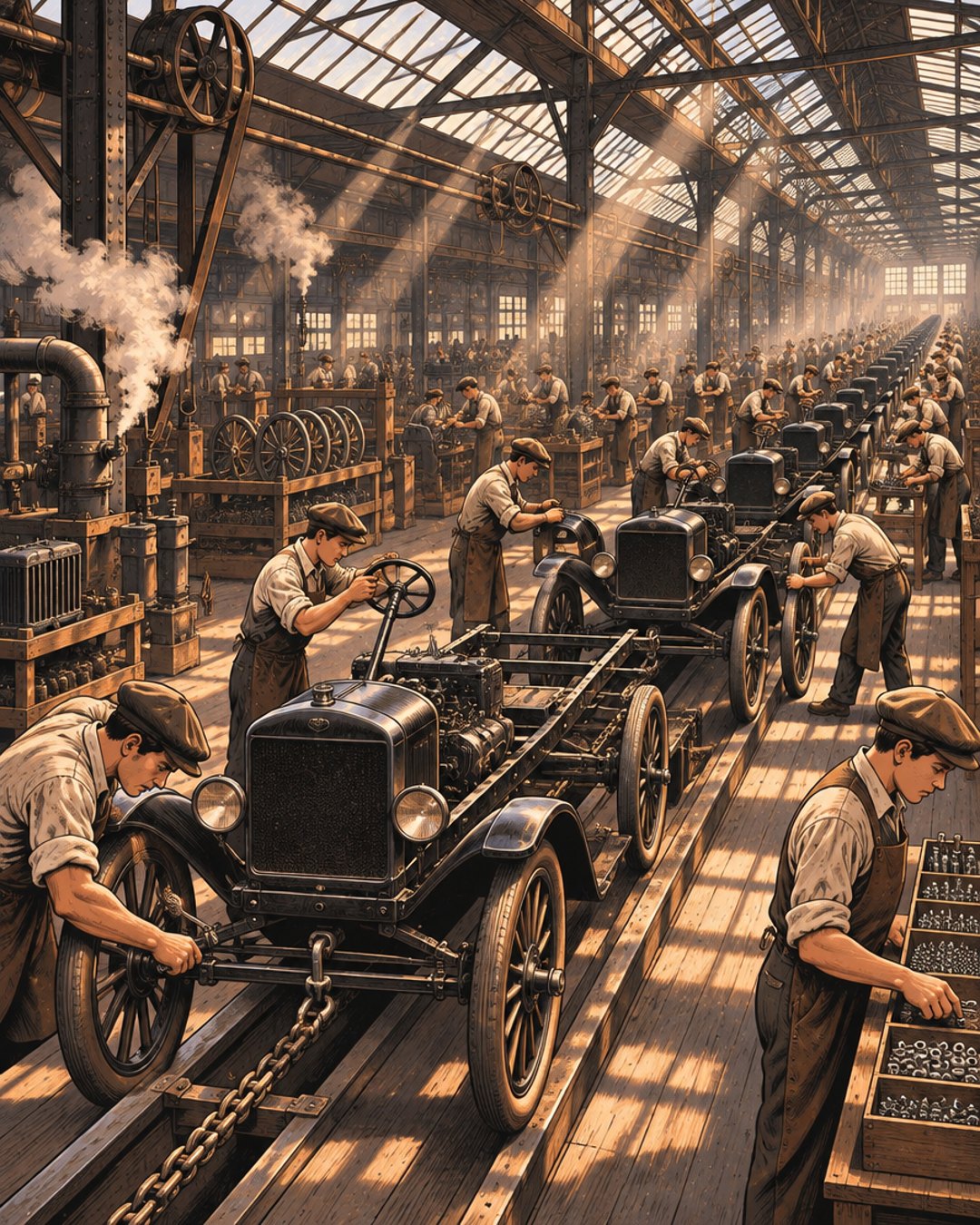
Demand for the Model T grew faster than it could be built. Five years after the debut, Ford and his engineers launched a moving assembly line at the new plant in Highland Park. Now it was not the workers who walked around the car, but the chassis that crawled past them on a rope, with each worker performing a single operation.
Part of the idea was borrowed from the Chicago slaughterhouses, where carcasses moved along an overhead line. The result was striking: a chassis that used to take more than twelve hours to assemble was now put together in about an hour and a half. The price crept down, the volumes went up. Soon every second car in America was a Ford.
What did "five dollars a day" mean at Ford's factory?

Now let's return to the gates. In January 1914 Ford announced pay of five dollars for an eight-hour day, more than twice the usual rate. The assembly line delivered speed, but people could not stand the monotony and quit en masse. Ford decided to keep them with money. Part of the sum was paid as profit sharing, with conditions on the worker's way of life, which a special company department monitored.

The news spread across the country, and thousands of job seekers converged on Highland Park. When the crowd began pressing against the gates, fire hoses were turned on the people, even though it was bitterly cold outside. The water froze on their clothes, but nobody left. A chance at such pay was worth the cold.
Behind this was calculation, not charity. High wages plus a price that had fallen more than threefold — and a worker could buy the very same Ford he was building. The automobile stopped being a luxury and became part of an ordinary Sunday drive out of town.

The Model T drove on dirt roads, most often with the top down. Dust from under the wheels settled right on the seats and the passengers' clothes. Today the cabin is closed, but road dust and fine particles have not gone anywhere: they get inside through the ventilation.
Hepa Series by DEIMAN are cabin filters with HEPA filtration. They trap fine particles before these get into the air the whole family breathes. For the Ford Focus, Kuga, Escape, Explorer and other models of the brand, filters of this series are already available.
Hepa Series for Ford: DHF2027 · DHF2010 · DHF2029
Find a DEIMAN filter for your car →

What went wrong: Edsel, Chevrolet and the dark side of Henry Ford

It seemed like the peak. But the bigger the success became, the less Henry listened to others. His son Edsel, who formally headed the company, asked to update the lineup: to add comfort, colors, modern design. His father repeatedly overturned his decisions.
Meanwhile General Motors was doing exactly what Edsel proposed: annual updates, a choice of colors, sales on credit. Chevrolet advanced, and Ford's share melted away. And Henry clung to the old "Lizzie" as if to proof that he had never been wrong.
There was a darker side too. Ford bought the newspaper The Dearborn Independent and for years printed antisemitic articles in it. They were later collected into a book, "The International Jew", which the Nazis eagerly translated and distributed. Ford apologized publicly only after a lawsuit and a boycott by customers. This part of the story cannot honestly be skipped.

What happened to the Model T and the Ford company next?

Nineteen years after the debut, the fifteen-millionth Model T rolled off the line. Henry finally agreed to a new car, and the plants stopped for months to retool for it. Thousands of workers were left without jobs, and Chevrolet meanwhile became the sales leader.
Edsel died of cancer at forty-nine, before his father. Henry outlived his son by almost four years and died at eighty-three.
Timeline
| Year | Event |
| 1863 | Henry Ford is born on a farm in Michigan |
| 1896 | First drive of the Quadricycle |
| 1903 | Founding of Ford Motor Company |
| 1908 | Debut of the Ford Model T |
| 1913 | Launch of the moving assembly line in Highland Park |
| 1914 | Announcement of $5-a-day pay |
| 1927 | The fifteen-millionth Model T and the end of its production |
| 1943 | Death of Edsel Ford |
Today Ford is one of the largest automakers in the world, and the Ford family still holds about 40% of shareholder votes. The board of directors is chaired by the founder's great-grandson, Bill Ford.
But America remembered Henry not for the newspaper and not for his stubbornness. It remembered the frost, the gates and the thousands of people waiting for their chance. The next episode of "Birth of Auto Legends" is a new story about a man who also went against everyone. And what do you think changed the world more: the Model T itself, the assembly line or five dollars a day?
Frequently asked questions
Who was Henry Ford?
Henry Ford was an American engineer and entrepreneur, the founder of Ford Motor Company. He was born on a farm in Michigan, worked as a mechanic and chief engineer at an electric company in Detroit, and in 1896 built his first car, the Quadricycle. He won worldwide fame with the Ford Model T, the moving assembly line and the $5-a-day wage, thanks to which the automobile became affordable for millions of people.
When did the Ford Model T appear?
The Ford Model T was introduced in the fall of 1908; sales began on October 1. The first cars were built at the plant on Piquette Avenue in Detroit. Production was later moved to the plant in Highland Park, where the moving assembly line went into operation. The model was produced until 1927, and over that time more than 15 million units were built.
Why was the Ford Model T called "Tin Lizzie"?
The nickname "Tin Lizzie" appeared spontaneously, and its exact origin is still debated. According to the most common version, "Lizzie" was what simple, hardy workhorses were commonly called at the time, while "tin" emphasized the car's cheapness and simplicity. The name "Model T" itself means nothing: Ford simply designated his models with letters of the alphabet.
How much did the Ford Model T cost?
At launch, a basic Ford Model T cost about $825. Thanks to the assembly line and mass production the price kept falling, and in the mid-1920s the simplest version could be bought for about $260. That is, the car became more than three times cheaper, and even a Ford factory worker could afford it.
How many Ford Model Ts were produced?
From 1908 to 1927, more than 15 million Ford Model Ts were produced. The fifteen-millionth car rolled off the line in May 1927. This production run was a record for a single model for almost half a century, until it was surpassed by the Volkswagen Beetle in the early 1970s.
When did Ford launch the assembly line?
The moving assembly line for the Ford Model T was launched in late 1913 at the Highland Park plant. The chassis was pulled by a rope past the workers, with each performing one operation. Chassis assembly time dropped from more than twelve hours to about an hour and a half, which made it possible to sharply increase output and lower the price of the car.
What is Ford's "five dollars a day"?
In January 1914, Henry Ford announced pay of $5 for an eight-hour day, more than twice the usual rate. This was how he fought the mass quitting of workers worn down by the monotonous labor on the assembly line. Part of the sum was paid as profit sharing with conditions on the worker's way of life. Thousands of people converged on the plant, and in the frost the crowd was dispersed with fire hoses.
Why was the Ford Model T only black?
In fact, the first Model Ts were painted in different colors. From roughly the mid-1910s to the mid-1920s they were made only in black. The most common explanation is this: black enamel dried faster and did not slow down the assembly line. Hence the well-known phrase from Ford's autobiography about any color as long as it is black.
How many companies did Henry Ford found before Ford Motor Company?
Before Ford Motor Company, Henry Ford took part in two car companies. The first assembled about two dozen cars in roughly a year and a half and closed without a profit. He left the second a few months later after a conflict with investors, and it later became known as Cadillac. He founded Ford Motor Company in 1903, when he was 39.
What engine did the Ford Model T have?
The Ford Model T had an inline four-cylinder engine with a displacement of about 2.9 liters and 20 hp. It worked together with a planetary transmission that had two forward speeds and was shifted with pedals. The design was simple so that the owner, a farmer for example, could maintain and repair the car himself.
Who runs Ford today?
Ford Motor Company is a public company, but the Ford family, thanks to a special class of shares, still holds about 40% of the votes. The board of directors is chaired by Bill Ford (William Clay Ford Jr.), Henry Ford's great-grandson. So it is one of the few car companies in the world where the founder's descendants still retain influence.